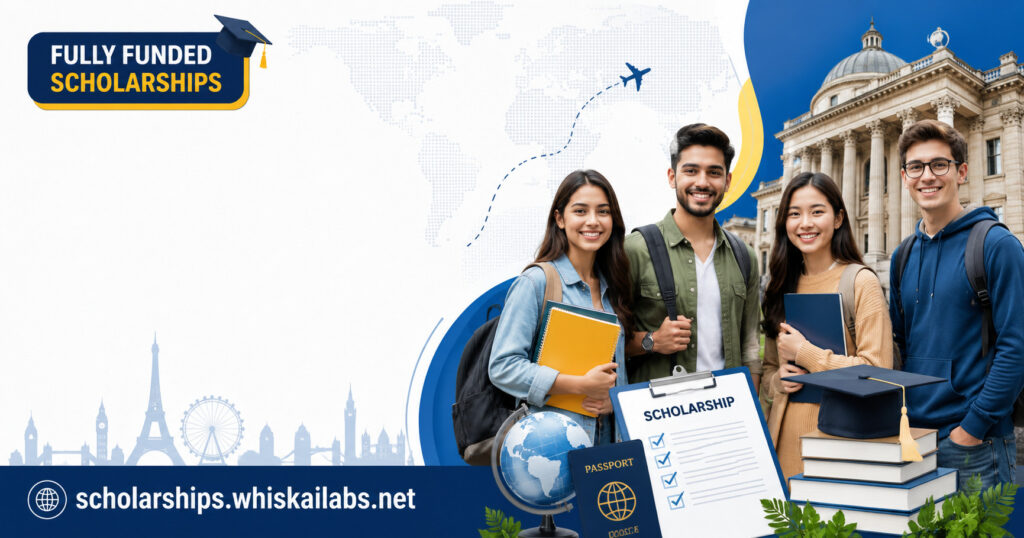
Fully Funded Scholarships in Germany 2026 for International Students. Germany has quietly become one of the most attractive destinations for international students looking for world-class higher education without crippling debt. Unlike the United States or the United Kingdom, most public universities in Germany charge zero tuition fees, even for foreign nationals. When you add fully funded scholarships on top of that, studying in this country becomes genuinely affordable.
Every year, thousands of students from developing countries and beyond receive financial aid through German government scholarships, political foundation awards, and European Union programmes. Whether you are pursuing a bachelor’s degree, a master’s degree, or a PhD, there is likely a funding opportunity waiting for you. This guide walks you through the biggest and most reliable scholarship programmes available in Germany for the 2026 academic cycle and beyond.
🌍 More Available Scholarships

I have personally guided dozens of applicants through the German scholarship application process, and I can tell you that the biggest mistake people make is not knowing which programmes exist. Let’s fix that.
Why Study in Germany on a Scholarship
Germany is not just another study abroad destination. It is an economic powerhouse home to Fortune 500 companies, cutting-edge research opportunities, and a knowledge economy that values practical training alongside theoretical depth. Tuition-free universities across the country – including global heavyweights like TU Munich, Heidelberg University, LMU Munich, Humboldt University, and Free University Berlin – offer English-taught programmes that rival anything you will find in the English-speaking world.
The cost of living in Germany is surprisingly manageable. Cities like Leipzig, Dresden, and Chemnitz allow students to live comfortably on a modest budget, while even Munich and Berlin remain far cheaper than London or New York. The average semester contribution at a public university ranges from 150 to 350 euros, which typically includes a semester ticket for unlimited public transport.
Beyond academics, Germany provides a clear pathway to employment after graduation. International graduates can apply for an 18-month job seeker visa (now called the post-study work permit), giving them ample time to find career opportunities in engineering programmes, STEM courses, and dozens of other fields. The multicultural environment, access to the Schengen visa zone, and robust student-friendly country policies make it an obvious choice.
🌍 More Available Scholarships
What truly sets Germany apart is the sheer volume of education grants and merit-based scholarships available. Political foundations, the federal government, private corporations, and the European Union all pour money into supporting talented students. The combination of quality education, affordable living costs, a globally ranked university system, and strong employability and graduation outcomes is hard to beat anywhere else.
DAAD Scholarships for International Students
The German Academic Exchange Service, universally known as DAAD, is the largest funding organisation for international academic exchange in the world. Headquartered in Bonn, the DAAD funds more than 100,000 scholars annually across every academic level — from undergraduate admissions to postdoctoral research.
DAAD scholarships come in several flavours. Study and research grants support students pursuing a full master’s degree or PhD scholarship at a German university. Short-term scholarships fund research stays of one to six months. Long-term scholarships cover complete degree programmes. The monthly stipend for master’s students is currently 861 euros, while doctoral and postdoctoral candidates receive between 1,200 euros and 1,400 euros per month. Most awards also include health insurance, a travel allowance, and a tuition fees waiver.
The application process runs through the DAAD portal, an online application system that centralises all required documents. You will need academic transcripts, degree certificates, recommendation letters, a motivation letter, proof of English proficiency (typically an IELTS or TOEFL score), and sometimes a German language certificate. Specific GPA requirements vary by programme, but academic excellence is always a core criterion.
Application deadlines depend on whether you are targeting the winter semester or summer semester intake, and they differ by subject-related scholarship category. DAAD also maintains regional offices worldwide that can help with academic counselling and navigating the scholarship database. Whether you want a bilateral exchange or a full graduate admissions pathway, the DAAD scholarship finder is your starting point.
Deutschlandstipendium – The Germany Scholarship
The Deutschlandstipendium — literally translated as the Germany Scholarship — is a unique partnership between the federal government and private donors. Unlike most awards on this list, it is a partial scholarship offering 300 euros monthly to talented students regardless of nationality.
Both undergraduate students and graduate students at participating German universities (including public universities and private universities) are eligible. Selection is based on academic performance, social engagement, extracurricular activities, and sometimes personal circumstances like family background. Strong GPA requirements and proven civic engagement or volunteering matter greatly.
The scholarship is renewable and typically lasts for at least two semesters. Corporate sponsors contribute half the funding, while the federal government matches it. This model means that the Deutschlandstipendium is not just a financial transaction — it often opens doors to mentoring, networking events, and internship opportunities with the sponsoring companies.
To apply, you submit your university application directly through your institution’s scholarship office. Each university sets its own application deadline and selection criteria. While 300 euros might not cover all living expenses, it can significantly ease the burden of campus housing, student banking fees, or daily costs when combined with other financial support sources.
Heinrich Böll Foundation Scholarships
The Heinrich Böll Foundation is closely aligned with Germany’s Green Party and ranks among the most generous political foundations offering fully funded scholarships to international students. If you care about sustainability, environmental policy, human rights, democracy, and gender equality, this programme deserves your full attention.
Master’s students receive a monthly stipend of approximately 934 euros, while doctoral candidates get around 1,350 euros. Additional benefits include health insurance, a family allowance, and a book allowance. The foundation supports students across virtually all academic disciplines — from social sciences and humanities to natural sciences and interdisciplinary studies.
The application process involves submitting a detailed motivation letter, recommendation letters, and evidence of political engagement or civic participation. Shortlisted candidates are invited for an interview process that explores their worldview, values, and commitment to social justice. The foundation explicitly values diversity and encourages applications from people with unconventional academic paths.
Application deadlines typically fall around March 1 for the following academic year. You do not need to be enrolled at a German university at the time of application, but you must have secured admission by the time the scholarship begins. Proficiency in the German language or acceptance of English-taught programmes is required depending on your chosen graduate programme.
Konrad-Adenauer-Stiftung Scholarship
The Konrad-Adenauer-Stiftung (KAS) is a political foundation associated with Germany’s CDU (Christian Democratic Union). It offers fully funded scholarships to international students who demonstrate a commitment to democratic values, social responsibility, and leadership development.
Like other political foundation awards, the KAS provides a monthly stipend of approximately 934 euros for master’s students and 1,350 euros for PhD candidates. Benefits also include health insurance, a book allowance, and a study allowance. The foundation places particular emphasis on fields like public policy, international relations, law studies, social sciences, economics, and political science.
The selection process values civic engagement, community service, and a genuine interest in European integration and transatlantic relations. Applicants must submit a motivation letter and recommendation letters and participate in a rigorous interview. KAS looks for individuals who aspire to become future leaders grounded in conservative values and Christian democratic principles, though applicants of all backgrounds are welcome.
Application deadlines vary — generally around July 15 for the winter semester. Working with an education consulting professional or your university’s academic counselling office can help you craft a competitive application that highlights your alignment with KAS values.
Friedrich Ebert Stiftung Scholarship
The Friedrich Ebert Stiftung (FES) is affiliated with Germany’s Social Democratic Party (SPD) and is one of the oldest political foundations in the country. Its fully funded scholarship programme targets talented international students who identify with social democracy, social justice, and democratic participation.
Master’s students receive approximately 850 euros monthly, while doctoral candidates get around 1,200 euros, plus health insurance and a study allowance. The FES specifically encourages applications from students with disadvantaged backgrounds and those from developing countries, making it one of the more inclusive need-based scholarships available.
Applicants should demonstrate academic excellence alongside strong community engagement, civic participation, and leadership qualities. The foundation values connections to trade unions, the labour movement, and workers’ rights advocacy. Fields like social sciences, political science, humanities, economics, law, and public policy are particularly well represented.
The application process requires a motivation letter, recommendation letters, and active engagement in social or political issues. Application deadlines roll throughout the year depending on the intake. The FES is an outstanding option for anyone whose personal story aligns with the values of equality and participatory democracy.
DAAD EPOS Scholarship for Developing Countries
The DAAD EPOS (Development-Related Postgraduate Courses) scholarship is specifically designed for professionals from developing countries who want to pursue a master’s degree at a German university and then return home to contribute to homeland development.
This fully funded scholarship provides a monthly stipend of 934 euros, along with health insurance, a travel allowance, a tuition fees waiver, and a study allowance. Programmes covered include development studies, sustainable development, public health, engineering, agriculture, economics, environmental management, urban planning, and natural resources management.
Fully Funded Scholarships in Finland for International Students 2026-2027
A key eligibility criterion is a minimum of two years of professional experience in a development-related field. This is not a scholarship for fresh graduates — the DAAD wants candidates who understand real-world challenges and will use their postgraduate education for capacity building back home. Applications are submitted through the DAAD portal via online application, and you will need all standard documents, including academic transcripts, recommendation letters, a motivation letter, and proof of English proficiency through IELTS or TOEFL.
The 2027–28 intake is expected to open for applications around October 2027. The programme offers postgraduate opportunities across numerous German universities, and the career opportunities after completion are substantial for development professionals.
Erasmus Mundus Joint Master’s Degrees in Germany
The Erasmus Mundus programme, funded by the European Commission under the broader Erasmus+ programme, offers some of the most prestigious fully funded scholarships available to international students anywhere in the world. These are joint master’s degree programmes delivered by a consortium of multiple European universities, with many involving at least one German university.
The financial package is exceptionally generous: full tuition fees covered, a monthly allowance for living costs, travel costs reimbursement, an installation allowance, and comprehensive insurance coverage. Unlike most other scholarships, Erasmus Mundus lets you study in two or three different European countries during your degree, creating a truly international experience and a global network of alumni.
Programmes tend to be interdisciplinary, highly specialised, and delivered entirely in English (English-taught programmes). The application process requires a strong GPA, excellent English proficiency (evidenced by IELTS or TOEFL), recommendation letters, and a compelling motivation letter. Each consortium sets its own application deadline, typically between October and January.
This is a merit-based scholarship in the purest sense — only top-performing candidates are selected. Cultural exchange, academic excellence, and international mobility are core pillars. If your dream is to study at top universities across Europe while being fully funded, Erasmus Mundus should be at the top of your list.
Einstein International Postdoctoral Fellowship
The Einstein International Postdoctoral Fellowship is a highly competitive research fellowship funded by the Einstein Foundation Berlin. It targets early-career international researchers who hold a doctoral degree and want to conduct postdoctoral research at one of Berlin’s leading institutions.
Eligible host universities include Free University Berlin, Humboldt University, Technical University Berlin, and Charité — Berlin’s world-renowned university hospital. The fellowship provides a generous monthly stipend, research grant funding, and access to Berlin’s vibrant scientific community. Fellows work on interdisciplinary research across STEM, natural sciences, social sciences, and humanities.
Applicants must submit a detailed research proposal, a strong publication record, and recommendation letters from established scholars. The application process evaluates academic excellence, the originality of the proposed research, and the candidate’s potential for lasting impact. PhD holders from any country are eligible, and international mobility is strongly valued.
This fellowship represents a significant step in building an academic career at the highest level. The combination of Berlin’s dynamic innovation ecosystem and the foundation’s commitment to knowledge exchange makes this one of the most attractive postdoctoral opportunities in Europe.
Helmut Schmidt Programme for Public Policy
The Helmut Schmidt Programme is a DAAD-funded scholarship that covers the full cost of the Master of Public Policy (MPP) degree at the prestigious Hertie School in Berlin. It is designed for mid-career professionals from developing countries and transition countries who are passionate about public policy, governance, and leadership.
The scholarship is fully funded: tuition fees covered, a monthly stipend, health insurance, and a travel allowance. Candidates must have at least two years of professional experience in a relevant field and demonstrate a clear commitment to driving reform in their home countries.
The application process requires proof of English proficiency (IELTS or TOEFL), recommendation letters, a motivation letter, and a strong professional track record. The programme covers public administration, international relations, policy analysis, and related areas. The application deadline is typically December 1 for the following autumn intake.
This is a government scholarship that specifically seeks reform-orientated professionals with proven political leadership or civic engagement. Graduates of the Helmut Schmidt Programme have gone on to hold prominent positions in governments, international organisations, and NGOs worldwide.
How to Apply for German Scholarships
The application process for German scholarships can feel overwhelming at first, but it follows a fairly predictable structure once you understand the steps. Here is a step-by-step guide that applies to most programs.
First, identify your target scholarships using the DAAD scholarship finder or the scholarship database on Studying-in-Germany.org. Filter by your academic level — undergraduate admissions, graduate admissions, or PhD admissions — and your field of study. Start at least 12 months before your intended enrolment to give yourself a comfortable application timeline.
Next, gather your required documents: academic transcripts, degree certificates, a passport copy, a curriculum vitae, recommendation letters, a motivation letter (or statement of purpose), and proof of English proficiency via IELTS score or TOEFL score. Some programmes also require a German language certificate, such as TestDaF or DSH, a research proposal, or a portfolio. Every document should be current, translated into English or German, and certified where required.
Submit your online application through the application portal — usually the DAAD portal or the university’s own system. Pay close attention to the application deadline; many programmes have strict cutoffs for the winter semester and summer semester. After shortlisting, you may be invited for an interview. Interview preparation and mock interviews with a mentor or study abroad consultant can make a real difference.
Finally, patience matters. The selection process can take several weeks. Once you receive your acceptance letter and notification, you can begin your student visa application and plan your move. Working with an education consulting firm or your university’s academic counselling office can streamline everything.
Eligibility Criteria for Scholarships in Germany
Eligibility criteria vary significantly across programmes, but several common requirements apply to nearly all German scholarships for international students.
Academic excellence is non-negotiable. Most programmes expect a strong GPA — often a minimum equivalent of 2.5 on the German scale (which corresponds to roughly a B+ average internationally). Your academic transcripts and degree certificates must come from an accredited university or recognised institution. Some scholarships are restricted by nationality requirements — for example, DAAD EPOS targets developing countries — while others are open globally. A few programmes impose an age limit, typically between 30 and 36 years.
Language proficiency is critical. Depending on the programme, you will need to demonstrate English proficiency through IELTS (usually 6.5+) or TOEFL (usually 90+) or German language proficiency through TestDaF or DSH. English-taught programmes generally waive the German requirement, but some institutions still prefer basic German skills.
Beyond academics, many scholarships value work experience, research experience, publication records, extracurricular activities, community service, and leadership qualities. Political foundation scholarships place particular weight on political engagement and civic participation. Need-based scholarships may also assess financial need. Always check the specific application requirements and eligible countries list before investing time in an application.
Ensuring you meet every requirement before applying saves enormous time and prevents frustration. Create a checklist for each scholarship application covering admission requirements, documentation, language scores, and deadlines.
Cost of Living and Tuition Fees in Germany
One of Germany’s biggest draws is the absence of tuition fees at most public universities. International students pay only a semester contribution — typically between 150 and 350 euros — which covers administrative costs, student union services, and often a semester ticket for unlimited public transport in the region.
Monthly living expenses for a student in Germany average around 934 euros, though this varies dramatically by city. Munich is the most expensive, with rents often exceeding 700 euros for a small apartment. Berlin, Hamburg, Frankfurt, and Cologne are also pricey but manageable. Smaller cities in eastern Germany offer affordable options with rents as low as 250 euros. Campus housing through the Studentenwerk (student services) is the cheapest option, but demand is fierce.
Health insurance is mandatory and costs approximately 110 euros monthly for students under 30 at a public insurer. Other expenses include food (200–250 euros), study materials (20–50 euros), internet costs, mobile phone plans, and leisure activities. A realistic monthly budget for most students falls between 850 and 1,100 euros.
To obtain a student visa, you must open a blocked account with a minimum balance of 11,208 euros (the current annual requirement). This serves as financial proof that you can support yourself. Part-time campus jobs are allowed for up to 20 hours per week during the semester, and mini jobs or working student positions can supplement your income. Combining a scholarship with part-time work and smart savings tips makes Germany remarkably accessible for international students on tight budgets.
Student Visa and Immigration Requirements for Germany
If you are from outside the EU, you will need a German student visa to study in the country. The correct visa type is the national visa (Type D visa), which you apply for at the German embassy or German consulate in your home country.
The required documents for a visa application typically include a valid passport, recent passport photos, your university admission letter (university acceptance), proof of financial means (the blocked account with 11,208 euros), health insurance documentation, travel insurance, the enrolment certificate, and proof of accommodation. The visa fees are approximately 75 euros, and processing time ranges from 6 to 12 weeks, so apply early.
A visa appointment at the embassy usually includes a short visa interview where you explain your study plans and financial arrangements. After arriving in Germany, you must register at the local foreigner’s registration office (Ausländerbehörde) and obtain a residence permit (Aufenthaltstitel). You will provide biometric data and may need to show additional documents. Scholarship holders sometimes enjoy a streamlined process.
After completing your degree, you can apply for the post-study work permit, which grants 18 months to find a job related to your studies. This pathway to a full work permit and eventual permanent residency is one of Germany’s strongest selling points. Understanding immigration policy, working with a trusted immigration consultant or visa services for students provider, and preparing all documents in advance will make the process far less stressful.
Tips to Win a Fully Funded Scholarship in Germany
Winning a fully funded scholarship in Germany is competitive, but not impossible if you approach it strategically. Here is what actually works, based on years of observing successful applicants.
Your motivation letter is the single most important document. It must be personal, specific, and genuine. Avoid generic statements — explain exactly why you chose this programme at this university, how it connects to your career goals and future plans, and what you will contribute to the academic community. Every sentence should reveal something meaningful about your unique story. Follow standard motivation letter tips: keep it under two pages, maintain a clear structure, and proofread mercilessly.
Recommendation letters should come from people who know your work intimately — professors who supervised your thesis, employers who witnessed your professional experience, or mentors who can speak to your leadership and community service. Generic letters from famous people who barely know you carry little weight.
Apply broadly. Use the scholarship database to identify every programme you qualify for, and submit multiple applications. Prepare backup options in case your first choice does not come through. Start IELTS preparation or TOEFL preparation early — a high score opens doors. Learn basic German language even for English-taught programmes; it shows commitment and helps during TestDaF preparation.
Networking matters more than most applicants realise. Connect with alumni, reach out to potential professors at your target university, and engage with the programme’s research community. Interview preparation — including mock interviews with friends or mentors — builds confidence and helps you articulate your vision with authenticity. Finally, respect every application deadline, have someone do an application review before you submit, and never stop refining your approach. Persistence is the one quality every successful scholarship winner shares.
Frequently Asked Questions (Latest Google People Also Ask)
Can international students study in Germany for free?
Yes, most public universities in Germany charge no tuition fees for international students, regardless of nationality. You only pay a small semester contribution of 150 to 350 euros. However, living expenses — including accommodation, health insurance, food, and transportation — still need to be covered through savings, part-time work, or a scholarship. Private universities do charge tuition, so always verify before applying.
What is the easiest fully funded scholarship to get in Germany?
No scholarship is truly “easy”, but the Deutschlandstipendium has a relatively straightforward application process since you apply directly through your German university. It awards 300 euros monthly based on academic performance and social engagement. For a comprehensive fully funded scholarship, the DAAD study grants and political foundation awards offer the most seats and are accessible to applicants from a wide range of countries.
Do I need to speak German to get a scholarship in Germany?
Not necessarily. Many master’s degree and PhD programmes are offered as English-taught programmes, and scholarships like DAAD, Erasmus Mundus, and the Helmut Schmidt Programme accept English proficiency scores from IELTS or TOEFL. However, learning basic German improves your daily life, strengthens your application, and can be a requirement for some programmes at the bachelor’s degree level.
How much money do German scholarships pay per month?
Amounts vary. The Deutschlandstipendium pays 300 euros monthly. The DAAD provides between 861 euros (master’s) and 1,400 euros (postdoctoral). Political foundations like the Heinrich Böll Foundation and Konrad-Adenauer-Stiftung offer 934 euros to 1,350 euros monthly plus allowances. Erasmus Mundus covers tuition and provides a living allowance. The exact scholarship amount depends on the programme, your academic level, and the specific funding organisation.
What is the blocked account requirement for a German student visa?
To obtain a German student visa, you must open a blocked account with a minimum of 11,208 euros, which serves as financial proof that you can cover one year of living expenses. You can withdraw approximately 934 euros per month. Scholarship holders who receive a stipend covering this amount may be exempt from the blocked account requirement, depending on the German embassy’s guidelines.
Can I work while studying in Germany on a scholarship?
Yes, most student visa holders are allowed to work up to 20 hours per week during the semester and full-time during breaks. Mini jobs and working student positions are popular options. However, some scholarships — particularly DAAD awards — may have restrictions on outside employment opportunities. Always check your specific scholarship terms before taking on campus jobs or freelance work.
What GPA do I need for a scholarship in Germany?
GPA requirements differ by programme. A general rule of thumb is a minimum equivalent of 2.5 on the German grading scale (where 1.0 is the best), roughly corresponding to a B+ or 3.0 on the US 4.0 scale. Highly competitive scholarships like Erasmus Mundus and the Einstein International Postdoctoral Fellowship often expect significantly higher grades along with a strong publication record or research experience.
When should I start applying for German scholarships?
Start at least 12 months before your intended enrolment date. Many application deadlines fall between October and March for programmes beginning the following winter semester. Early application gives you time to prepare strong documents, secure recommendation letters, take language proficiency tests, and explore backup options. Using a scholarship database like the DAAD scholarship finder helps you map out all relevant deadlines.
Conclusion
Germany offers one of the most generous and accessible scholarship landscapes in the world for international students at every academic level. From the DAAD and political foundations to Erasmus Mundus and postdoctoral fellowships, the pathways to fully funded education are real and well-documented. The key is starting early, crafting authentic applications, and understanding that every successful scholarship application reflects genuine preparation, purpose, and persistence.
Official Scholarship & University Resources
Use these official sources to check live application windows and full eligibility details before applying – third-party blogs can become out of date quickly:
- DAAD Scholarship Database: https://www2.daad.de/deutschland/stipendium/datenbank/en/
- DAAD official scholarships overview: https://www.daad.de/en/studying-in-germany/scholarships/daad-scholarships/
- Erasmus Mundus Joint Masters (student portal and course catalogue): https://erasmus-plus.ec.europa.eu/opportunities/individuals/students/erasmus-mundus-joint-masters
- Deutschlandstipendium official information: https://www.deutschlandstipendium.de/
- DAAD EPOS program deadlines list: https://www.daad.de (search “EPOS deadlines” for the current PDF list)
Official Scholarship & University Resources
| Resource | Official Link | Deadline / Status |
|---|---|---|
| DAAD Scholarship Database | Apply Link | Rolling / Varies by Program |
| DAAD Scholarship Finder Portal | Apply Link | Currently Open |
| Deutschlandstipendium Official Page | Apply Link | Varies by University |
| Heinrich Böll Foundation Scholarships | Apply Link | Varies |
| Konrad-Adenauer-Stiftung Scholarships | Apply Link | July 15, 2026 (Approx.) |
| Friedrich Ebert Stiftung Scholarships | Apply Link | Rolling / Varies |
| Erasmus Mundus Joint Master Degrees | Apply Link | Varies by Consortium |
| Helmut Schmidt Programme (Hertie School) | Apply Link | Varies |
| Einstein Foundation Berlin Fellowships | Apply Link | Currently Open |
| German Embassy Visa Information | Apply Link | Always Available |
| Studying in Germany Official Portal | Apply Link | Always Available |
| DAAD EPOS Postgraduate Scholarships | Apply Link | Varies |